
Best Fragrance for Every Room: A Room-by-Room Guide for Indian Homes
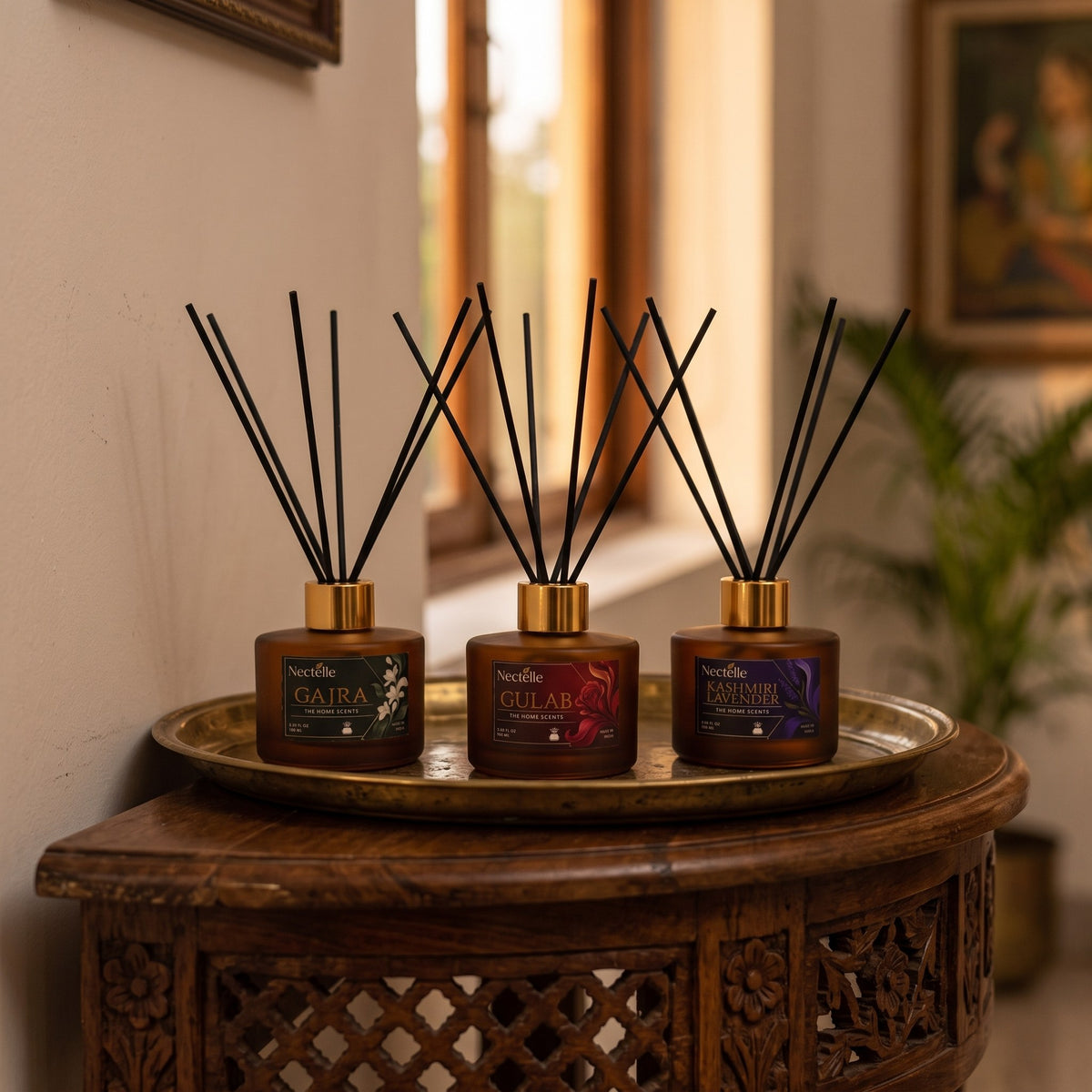
The best fragrance for each room depends on what the room is for. A bright floral like jasmine works at the entry, where it has to greet people through an opening door. A warm, familiar rose suits the living room and shared spaces. A quieter lavender belongs in the bedroom. And the kitchen and puja room are best left to their own smells.
Below is a room-by-room guide written for the way Indian homes actually work: shoes at the door, the fan always on, chai in the drawing room, the AC running all night in May.
The quick map
|
Room |
What the room needs |
Scent to start with |
Reeds |
Where to put it |
|---|---|---|---|---|
|
Entry and hallway |
A welcome that survives the door opening |
Gajra |
4 to 5 |
On a console beside the door, out of the draft |
|
Living or drawing room |
Warmth for people, without drowning conversation |
Gulab (or Gajra if open to the entry) |
5 to 6 |
Side table or shelf, out of the fan's direct line |
|
Bedroom |
Quiet, cool, easy to sleep with |
Kashmiri Lavender |
3 to 4 |
Dresser or shelf, across the room from the bed |
|
Reading nook, study, home office |
Calm focus, not distraction |
Kashmiri Lavender |
2 to 3 |
A shelf behind or beside you, not on the desk |
|
Guest room |
A room that feels ready |
Gulab or Gajra |
3 |
Flip the reeds the day before guests arrive |
|
Powder room |
A small space that fills fast |
Gajra or Kashmiri Lavender |
2 |
A dry shelf, away from splashes |
|
Kitchen |
Leave it to the cooking |
None |
– |
Use the passage outside instead |
|
Puja room |
Agarbatti, dhoop, camphor |
None |
– |
Keep diffusers well away from diyas |
Reed counts are starting points for Nectélle diffusers, which are made at roughly twice the usual concentration. Lower-strength oils usually need more reeds.
Three rules before you start
- One scent per room. A room becomes recognisable when it smells the same for weeks. Switching every few days stops that from happening.
- Size the reeds to the room. Small room, fewer reeds. You can always add one; you can't un-finish a bottle.
- Respect the air. Fans, ACs, coolers and open balconies all move scent. Gentle air helps it travel. Fast air burns through it. For the details, see How to Use a Reed Diffuser.
Entry and hallway: Gajra
The entry is where a home introduces itself. It is also the hardest place to scent, because every time the door opens, the air changes.
That's why it needs a fragrance with lift. Jasmine opens up the moment you step in, the way a gajra does when someone passes you on the stairs. It reads as welcome without being sweet. Gajra Reed Diffuser was made for this spot: jasmine at the door, flowers in the hair, evening air.
Placement tip: put it on the shoe cabinet or a console a step or two inside the door, not in the doorway itself. Use four or five reeds, and flip them before guests arrive.
Living room: Gulab
The living room is shared. It holds the television, the evening chai, cousins who drop in unannounced. A scent here should feel familiar to everyone, not just to you.
Rose does that in an Indian home like nothing else. It is the smell of wedding mandaps and festival thalis and the cool sherbet that came out on hot afternoons. Gulab Reed Diffuser is that rose: warm, recognisable and never perfumey.
If your living room opens straight off the entry, you can keep Gajra flowing through instead. Jasmine and rose sit easily side by side, so an entry in Gajra and a living room in Gulab feels like one home, not two.
Placement tip: a side table or bookshelf at about waist height, a few feet out of the fan's direct line. Five or six reeds for a large drawing room; four for a compact one. Keep it a little away from the dining table so it doesn't compete with food.
Bedroom: Kashmiri Lavender
The bedroom should be the quietest room in the house, and its scent should be too. You want to notice it when you walk in at night, then forget it.
Lavender has long been the scent people reach for at the end of the day. Kashmiri Lavender Reed Diffuser opens soft and airy, settles into a true lavender heart, and dries down to cool eucalyptus. In a room closed up with the AC on, it stays clean rather than heavy.
Placement tip: a dresser or shelf across the room from the bed, not on the bedside table. Three or four reeds is plenty in a closed, air-conditioned bedroom. Keep it out of the AC's direct airflow.
Reading nook, study and home office
Since working from home became normal, many homes have a corner that's half study, half spare room. It needs calm more than character.
Kashmiri Lavender works well here at a low reed count, two or three. Place it behind or beside you on a shelf rather than on the desk, so it's in the room, not in your face during a long call.
Guest room
A guest room is often shut for weeks and then suddenly needed. Keep a diffuser there with two or three reeds so the room never smells closed. The day before guests arrive, flip the reeds. It's the scent version of fresh towels on the bed.
Gulab feels like hospitality; Gajra feels like a welcome. Either works.
Small apartments and 1BHKs
In a compact flat, one diffuser often serves two spaces. Put it somewhere central, such as the passage between the living area and the bedroom, and choose one scent for the whole home so nothing clashes. Start with three or four reeds; a small home fills faster than you'd expect.
If you'd like two, a pairing that works well is Gajra in the living area and Kashmiri Lavender in the bedroom with the door closed.
Open-plan homes
Where the living, dining and entry run into one another, think in zones rather than rooms. Pick scents that sit well together. Jasmine and rose blend naturally, while lavender is best kept to a room with a door. Place diffusers at opposite ends of the space so the scents meet softly in the middle rather than piling up in one corner.
Rooms to leave alone
The kitchen. Heat from the stove changes fragrance oil and speeds up evaporation, and no diffuser should compete with tadka. Place one in the passage outside instead, so the scent meets you as you leave the kitchen.
The puja room. It already has its own smells: agarbatti, dhoop, camphor, flowers. Let it keep them, and keep diffusers well clear of diyas. (We explain why in Reed Diffuser vs Candle vs Agarbatti.)
Giving every room its own scent
If you'd like to set up the whole home at once, The Home Scents Collection has all three: Gajra for the entry, Gulab for the living room, Kashmiri Lavender for the bedroom. Each is a 100 ml glass bottle with six reeds, flame-free, hand-poured in small batches in India, and lasts about 30 to 45 days. Free shipping across India on orders above ₹499.
For a closer look at why each scent feels the way it does, read Why Smell Triggers Memory.
Frequently asked questions
What is the best fragrance for a living room?
A warm, familiar floral that everyone in the home recognises. Rose is a natural choice in Indian homes, and jasmine works well if the living room opens onto the entry. Use five or six reeds in a large room.
What scent is best for a bedroom?
A soft, quiet scent you can sleep with, such as lavender. Use three or four reeds and place the diffuser across the room from the bed, away from the AC.
Where should I put a reed diffuser in my house?
Where people walk past: near the main door, in a passage, on a living-room side table. Avoid direct sun, fast fans, AC vents, the stove and anywhere near a diya.
Can I use different scents in different rooms?
Yes. One scent per room works best. In open-plan spaces, choose scents that blend, like jasmine and rose, and keep stronger contrasts to rooms with doors.
How many reed diffusers do I need for a 2BHK?
Usually two or three: one at the entry or living room and one in each bedroom you want scented. In a smaller home, one placed centrally can cover the living area.
Can I use a reed diffuser in a bathroom?
Yes, in a small bathroom or powder room with two reeds. Keep it on a dry shelf away from water splashes, and out of reach of children.


