
Why Smell Triggers Memory, and How to Make Your Home Smell Like Home
Why Smell Triggers Memory, and How to Make Your Home Smell Like Home
Smell triggers memory because the brain's smell pathway runs almost straight into the regions that handle emotion and memory. Sight and sound take a longer route. That is why a gajra on a stranger in a crowded metro can bring back your grandmother's evening plait before you have even named the flower.
It is also why the smell of a home matters more than we usually admit. Long after the furniture has changed, the smell is what people remember. This piece explains the science simply, then turns it into something practical: how to give your own home a scent that the people in it will carry with them.
What happens in your brain when you smell something
When you breathe in, scent molecules reach a small patch of nerve cells high inside the nose. Those cells send signals to the olfactory bulb, at the base of the brain.
Here is the unusual part. Most of what you see, hear and touch passes through a relay station, the thalamus, before reaching the parts of the brain that attach feeling and memory to it. Smell takes a shortcut. The olfactory bulb connects closely to the amygdala, which deals with emotion, and to the hippocampus, which helps form and recall memories.
So a smell often arrives as a feeling first. Comfort, longing, a sudden ache for a place. The name of the thing comes later, if at all.
Why scent memories feel so emotional, and so old
Researchers have been testing this for decades. Studies led by the psychologist Rachel Herz found that memories brought back by a smell tend to feel more emotional and more vivid than the same memories prompted by a picture or a sound, and brain imaging showed stronger activity in the amygdala when the cue was a smell.
There is also a curious pattern in which memories return. Swedish researchers found that memories triggered by smell tend to come from early childhood, often the first ten years of life, while memories cued by words or pictures cluster later, in the teens and twenties.
Writers noticed long before scientists did. Marcel Proust built a whole novel on the moment a crumb of cake dipped in tea brought his childhood back, and “the Proust effect” is now shorthand for exactly this.
We don't need a French cake to understand it. Most of us have our own:
- Jasmine strung into a gajra, pinned into hair at dusk.
- Rose petals on a wedding floor, and rose sherbet in steel bowls on a summer afternoon.
- The first rain on dry earth.
- Camphor and agarbatti at the evening aarti.
- A trunk of winter shawls opened for the first time in November.
None of these are “fragrances” in the shop sense. They are places and people, stored as smells.
Why you can't smell your own home
Every home has a smell. You just can't detect yours most of the time.
Your nose adapts to any smell it meets constantly, so it can stay alert to new ones. It is called olfactory adaptation, and it is why you notice your home's smell only when you come back from a long trip, for a minute or two, before it disappears again.
Guests don't have that adaptation. They notice everything at the door. It's worth remembering when you choose a home fragrance: the people who walk in will smell it more clearly than you will, and your children will remember it whether you notice it or not.
How to make your home smell like home
1. Start from a memory, not a fragrance family
Forget “woody” or “fresh” for a moment. Ask a different question. What did the best evenings of your childhood smell like? Who were you with? A scent chosen from that answer will feel right in a way a trend never does.
2. Give each room one scent, and stay with it
Repetition is what turns a smell into a memory. If the bedroom smells of something different every week, it never becomes the bedroom's smell. Pick one scent per room and let it settle in for months. Our room-by-room fragrance guide suggests where to start.
3. Put the scent where arriving happens
The entry is where a home introduces itself. A diffuser by the main door means the first breath after a long day is the same every time. That consistency is what the memory attaches to.
4. Keep it quiet
A home scent should be noticed on arrival and then fade into the background, the way a well-loved room does. If it announces itself from every corner, use fewer reeds. With a high-concentration diffuser, three or four reeds in a bedroom is usually enough. (More on this in How to Use a Reed Diffuser.)
5. Let it change with the seasons, not the week
Seasonal shifts feel natural. Rose through the festive months, jasmine through long summer evenings, something cooler in the bedroom when the nights warm up. Change too often and nothing has time to become familiar.
6. Make the new memories on purpose
The smells you remember from childhood were not chosen to be remembered. They were simply there, every day. Whatever your home smells like now is what someone in it will remember in twenty years. That is worth a little thought.
Where Nectélle begins
The name says it plainly: home, memory, air. Each of our scents starts from a memory most Indian homes already hold, not a trend board.
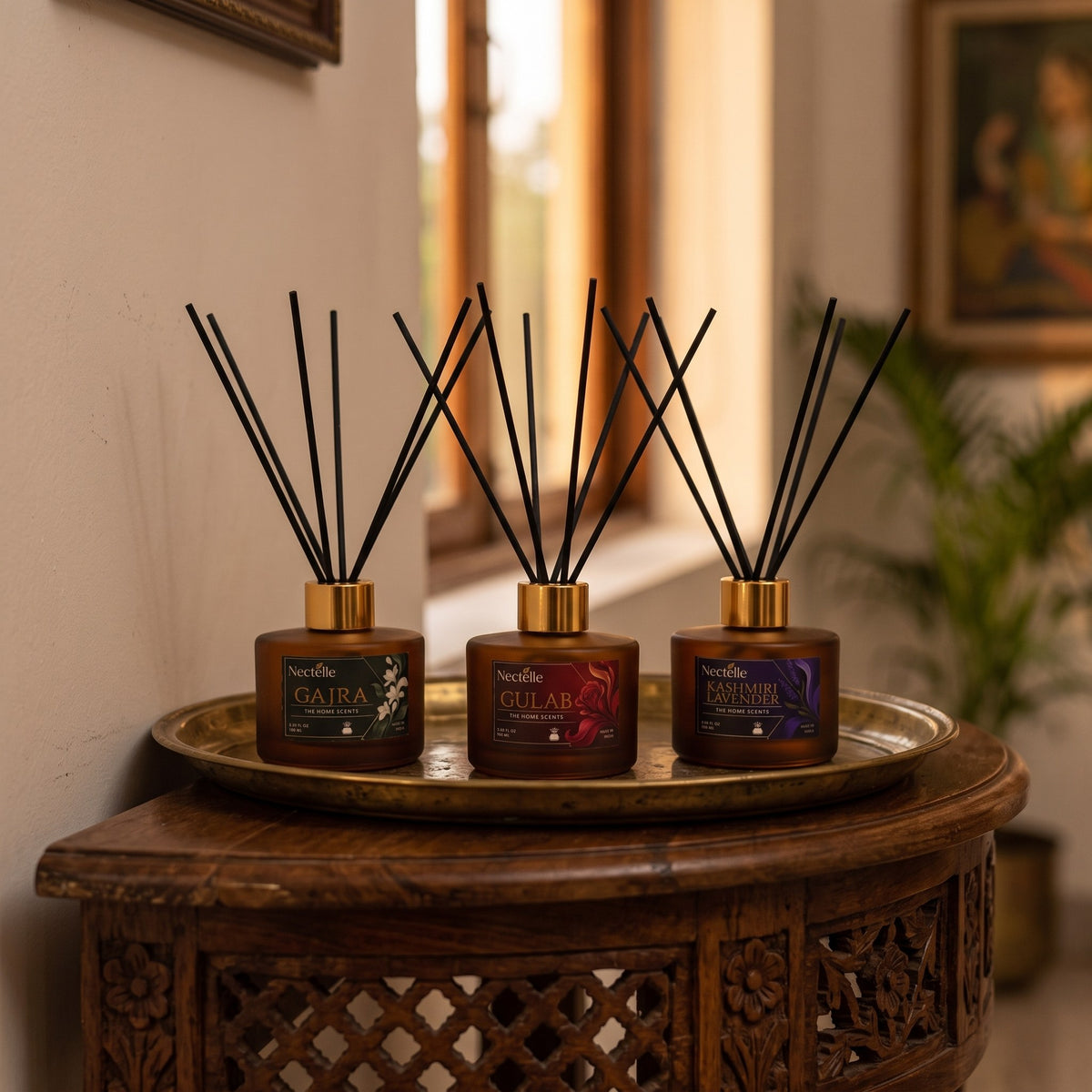
- Gajra Reed Diffuser. Jasmine at the door, flowers in the hair, evening air. Made for the entry, the hallway and the living room.
- Gulab Reed Diffuser. The rose you already know: wedding floors, steel bowls of sherbet, the familiar rose of festivals. For living rooms and the spaces everyone shares.
- Kashmiri Lavender Reed Diffuser. A soft, airy opening, a true lavender heart, a cool eucalyptus dry-down. For the bedroom, the reading nook and the quieter corners.
Each one is hand-poured in small batches in India, flame-free, and made to last about 30 to 45 days in the rooms you actually use. If you want to give every room its own memory, The Home Scents Collection holds all three. You can read more about why we started in our story.
Frequently asked questions
Why does smell trigger memories so strongly?
The brain's smell pathway connects closely to the amygdala and hippocampus, which handle emotion and memory. Other senses pass through a relay first. That direct route is why smells often bring back feelings before you can name what you're smelling.
Why do smells bring back childhood memories in particular?
Research suggests that memories triggered by smell tend to come from early childhood, often before age ten, more than memories prompted by words or pictures. Many of the scents we meet first are tied to home and family.
What is the Proust effect?
It's the name for a smell or taste suddenly bringing back a vivid, emotional memory. It comes from Marcel Proust's novel, in which cake dipped in tea returns the narrator to his childhood.
Why can't I smell my own house?
Your nose adapts to smells it meets all the time, so it stops registering them. You notice your home's smell briefly after time away. Guests notice it immediately.
How do I make my house smell like home?
Choose a scent tied to a memory you love, give each room one scent and keep it for months, place one near the main door, and keep it subtle. Consistency is what makes a smell feel like home.
Which scents feel most nostalgic in Indian homes?
It's personal, but jasmine, rose, sandalwood, camphor and the smell of first rain come up again and again. They are tied to festivals, prayer, weddings and childhood evenings.


